
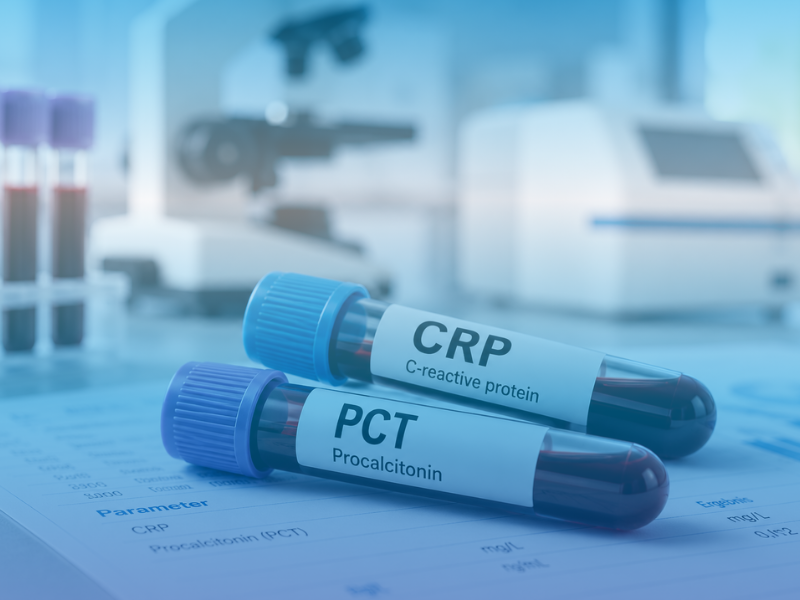
The differentiated assessment of inflammatory processes is one of the most common and, at the same time, most challenging tasks in clinical diagnostics. Particularly when a bacterial infection is suspected, the question arises as to which biomarker provides the most useful additional information in a given clinical situation. In addition to C-reactive protein (CRP), which has been established for decades, procalcitonin (PCT) has become an important marker particularly in systemic bacterial infections and within defined antibiotic stewardship strategies.
However, CRP and procalcitonin do not reflect the same pathophysiological processes. They differ in terms of biological regulation, kinetics, diagnostic specificity and clinical applications. PCT should therefore not be regarded simply as the “better CRP”, nor can CRP be replaced by PCT in every clinical situation.
The choice of marker should instead be guided by the diagnostic question: Is the aim to detect and monitor a general inflammatory response, or to assess a possible acute and systemic bacterial infection?
What is CRP?
C-reactive protein is an acute-phase protein produced by the liver. Its synthesis is stimulated during inflammatory responses, particularly by pro-inflammatory cytokines. Elevated CRP concentrations can occur in infectious and non-infectious inflammation, tissue damage, following surgical procedures, and in various immunological and malignant diseases.
CRP is considered a sensitive but non-specific marker of inflammation. An elevated value indicates that an inflammatory or tissue-damaging process may be present. However, the CRP concentration alone does not reliably identify either the cause of the inflammation or the type of infection.
In particular, a single CRP value cannot reliably distinguish between bacterial and viral infections. Nor can it determine the location of a potential source of infection. CRP results must therefore always be interpreted in conjunction with the patient’s medical history, clinical findings, vital signs, comorbidities and other diagnostic results.
Due to its broad availability and established use, CRP is particularly suitable for:
- assessing inflammatory activity,
- supporting the initial clinical assessment,
- monitoring the course of inflammatory diseases,
- postoperative monitoring,
- supplementary assessment of infectious processes, and
- monitoring the response to therapeutic interventions.
Serial measurements are often more informative than an isolated value. Changes over time can provide an indication of whether an inflammatory response is increasing, persisting or resolving.
What is Procalcitonin?
Procalcitonin is the precursor of the hormone calcitonin. Under physiological conditions, it is predominantly produced in specialised cells of the thyroid gland and rapidly metabolised, resulting in only very low PCT concentrations in the blood.
In severe systemic bacterial infections, however, increased procalcitonin production can occur in various tissues outside the thyroid gland, followed by its release into the bloodstream. This results in an increase in measurable PCT concentrations. Compared with CRP, PCT shows a closer association with systemic bacterial infections in certain clinical situations.
Procalcitonin is therefore used in particular for:
- supplementary assessment of suspected systemic bacterial infections,
- diagnostic support in suspected sepsis,
- assessment of disease progression,
- evaluation of the effectiveness of antibiotic treatment and limitation of treatment duration.
The Robert Koch Institute notes that PCT can support the differentiation between bacterial and viral infections. An increase may, for example, indicate a bacterial superinfection, but must be interpreted together with clinical signs and microbiological findings [2].
Procalcitonin is not a pathogen-specific marker and does not, on its own, confirm the presence of a bacterial infection. Localised infections may be associated with low PCT levels. Conversely, elevated PCT concentrations can also occur in certain inflammatory but non-infectious conditions.
What Is the Difference Between CRP and Procalcitonin?
The key difference lies in their diagnostic focus. CRP responds to a broad spectrum of inflammatory stimuli, whereas procalcitonin is more closely associated with a systemic bacterial response in certain clinical situations.
| Characteristic | CRP | Procalcitonin (PCT) |
|---|---|---|
| Biological marker | Acute-phase protein | Precursor of the hormone calcitonin |
| Main application | General assessment of inflammation and monitoring | Indication of systemic bacterial infections and support of antibiotic therapy |
| Increase | Within approx. 6–12 hours | As early as approx. 2–4 hours |
| Peak | After approx. 24–48 hours | After approx. 12–24 hours |
| Half-life | Approx. 19 hours | Approx. 24 hours |
| Particularly suitable for | Monitoring, non-specific inflammation | Sepsis, severe bacterial infections |
| Viral infections | Frequently elevated as well | Often only slightly elevated or not elevated |
| Non-infectious inflammation | Frequently elevated | Usually a smaller increase, depending on the cause |
| Sufficient on its own? | No | No |
| Recommendation | Always interpret together with clinical findings and further diagnostics | Always interpret together with clinical findings, microbiology and guidelines |
The characteristics of these markers should not be interpreted in isolation. Their diagnostic performance depends, among other factors, on the timing of sample collection, the site of infection, the severity of the systemic response and patient-specific factors.
CRP in Outpatient and Point-of-Care Diagnostics
Quantitative CRP testing can be particularly useful when performed as a point-of-care test.
Studies show that targeted use of CRP point-of-care testing in defined outpatient settings can contribute to a reduction in antibiotic use [5]. However, establishing a universally applicable cut-off value without considering the patient’s clinical findings is not appropriate.
CRP kinetics do not always correspond directly to the immediate clinical course. Due to biological variability, changes in laboratory values may follow clinical changes with a delay, or vice versa.
PCT in Suspected Sepsis and Monitoring of Antibiotic Therapy
Elevated PCT levels can provide additional diagnostic information when a systemic bacterial infection is suspected and there is a risk of sepsis.
Sepsis is a life-threatening organ dysfunction caused by a dysregulated host response to infection. Its diagnosis is not based on a single laboratory parameter. Clinical assessment, evidence of infection, the presence of organ dysfunction and timely microbiological, laboratory and, where appropriate, imaging diagnostics are essential.
A low procalcitonin level does not reliably exclude a bacterial infection. This applies, among other situations, to early stages of disease and localised infections. Medically urgent diagnostic procedures or treatment must therefore not be withheld solely on the basis of a low PCT result.
The current German S3 guideline on sepsis emphasises that necessary antibiotic treatment for sepsis or septic shock must not be delayed while awaiting biomarker results [1]. A normal or low PCT value is not sufficient justification for withholding necessary acute treatment.
A particularly relevant application of PCT is supporting decisions to limit the duration of antibiotic therapy that has already been initiated.
The German S3 guideline recommends measuring serum procalcitonin in patients with sepsis or septic shock to help limit the duration of antibiotic therapy, provided adequate infection control has been achieved. Exceptions include infections that inherently require prolonged treatment, such as Staphylococcus aureus bacteraemia, endocarditis or candidaemia [1].
The U.S. Food and Drug Administration has also evaluated PCT measurement as an aid in antibiotic management for certain lower respiratory tract infections and sepsis. The FDA emphasises its use within a clinical algorithm and in conjunction with other findings [4].
CRP or PCT in Respiratory Tract Infections?
Acute respiratory tract infections are among the most common reasons for diagnostic decisions regarding the use of antibiotics. Many uncomplicated respiratory tract infections are viral. At the same time, bacterial pneumonia and severe disease must be identified reliably.
In outpatient settings, CRP can provide additional guidance when clinical assessment alone does not allow a clear decision. Its value does not lie in an isolated classification of an infection as “viral or bacterial”, but rather in complementing a structured medical history and clinical examination.
PCT can be particularly helpful in more severe clinical presentations, inpatient settings and when assessing the possibility of relevant systemic bacterial involvement. In uncomplicated outpatient respiratory tract infections, however, routine PCT measurement is not required in every situation.
In both cases, clinical warning signs remain decisive. These include:
- dyspnoea or tachypnoea,
- impaired oxygenation,
- hypotension or circulatory instability,
- altered consciousness,
- marked deterioration in general condition,
- severe comorbidities, and
- signs of organ dysfunction.
Biomarkers must not replace or delay necessary further diagnostic investigations.
Should CRP and PCT Be Measured Together?
Combined measurement can provide additional information in complex clinical situations. The Robert Koch Institute lists CRP and PCT together with blood count, lactate, vital signs and identification of the infection source as possible components of diagnostic assessment [3]. Both biomarkers must therefore be integrated into a broader diagnostic approach.
Potential benefits of combined interpretation include:
- Elevated CRP with low PCT may occur, among other situations, in localised infections, early stages of disease or non-infectious inflammation.
- A marked increase in PCT can support suspicion of a clinically relevant systemic bacterial infection when consistent with the clinical presentation.
- Serial measurements of both markers can help provide a more differentiated assessment of changes in the overall inflammatory situation.
Discordant results are not necessarily contradictory. They may reflect differences in kinetics, timing of measurement or underlying pathophysiological processes. In such cases, one marker should not simply be weighed against the other. Instead, it should be assessed which result best corresponds to the clinical question and the course of the disease.
What Are the Limitations of CRP and Procalcitonin?
CRP can be elevated in a range of conditions, including autoimmune and rheumatological diseases, surgical procedures, trauma and burns, tissue necrosis, chronic inflammatory diseases and malignancies. This limits the specificity of an elevated CRP value.
Procalcitonin is also not completely specific. Elevated concentrations can occur in association with severe trauma, major surgery, burns, severe shock states or certain organ dysfunctions.
Interpretation can be particularly challenging in patients with impaired renal function. In such situations, baseline levels, clinical context and changes over time should be taken into account [6].
Low CRP or PCT levels do not exclude a clinically relevant infection with absolute certainty. Possible reasons include:
- very early sample collection,
- a localised infection,
- an attenuated immune response,
- certain infection sites or pathogens, and
- treatment that has already been initiated.
Laboratory results must therefore always be assessed in the context of the clinical findings.
Why Are Serial Measurements Often More Important Than Single Values?
A single measurement provides only a snapshot. Inflammatory markers change dynamically as an infection or inflammatory disease develops and responds to treatment.
Serial measurements can help address questions such as:
- Is inflammatory activity increasing or decreasing?
- Is the trend consistent with the clinical course?
- Are there signs of a persistent infection?
- Should an uncontrolled source of infection be investigated?
- Can antibiotic therapy be limited within a validated clinical strategy?
For PCT, changes over time can support decisions regarding discontinuation of antibiotic therapy when the appropriate clinical conditions are met [1]. CRP trends can also provide important information, although the response is often delayed.
Neither decreasing nor increasing values should be interpreted without considering the patient’s clinical course.
Point-of-Care CRP and PCT Testing with BIOspeed
Point-of-care diagnostics enable quantitative laboratory testing close to the site of patient care. This can make diagnostically relevant results available without the full transport and processing pathway required by a central laboratory.
BIOMED offers two compact immunofluorescence analysers for the quantitative determination of various parameters: BIOspeed Single and BIOspeed Multi.
BIOspeed Single processes one test cassette at a time and is particularly suitable for facilities with a manageable sample volume. BIOspeed Multi can evaluate up to six patient samples or parameters in parallel. Both systems use time-resolved fluorescence immunoassay technology.
The following test kits are available for the biomarkers discussed in this article:
Quantitative CRP Testing
The CRP rapid test kit for BIOspeed is intended for the quantitative determination of CRP and hsCRP. Human serum, plasma, capillary blood and whole blood can be used as sample materials. The test kit is compatible with both BIOspeed Single and BIOspeed Multi.
Quantitative PCT Testing
The PCT rapid test kit for BIOspeed is intended for the quantitative determination of procalcitonin in human serum, plasma and whole blood. It is designed as a diagnostic aid in the assessment of systemic bacterial infections and sepsis and can also be used with both BIOspeed analysers.
Additional analysers, test kits and accessories are available in the BIOMED category Point-of-Care Analysers and Accessories.
The availability of a test result at the point of care does not change its medical significance. POCT results must also be interpreted in accordance with the intended purpose, the relevant instructions for use, the clinical context and applicable quality assurance requirements.
Summary: CRP or Procalcitonin – Which Marker for Which Clinical Question?
CRP is often useful when …
- general inflammatory activity needs to be assessed,
- broadly applicable support for clinical assessment is required,
- the course of inflammation needs to be monitored,
- postoperative or therapeutic progress is being monitored, or
- additional diagnostic guidance is required in an outpatient setting.
Procalcitonin is often useful when …
- a systemic bacterial infection is suspected,
- sepsis or septic shock is being considered in the differential diagnosis,
- the course of a severe bacterial infection needs to be assessed, or
- the duration of antibiotic therapy is to be limited within an appropriate clinical algorithm.
Both markers can be useful when …
- a complex or severe clinical situation is present,
- general inflammatory activity and the systemic bacterial response need to be assessed separately,
- trends are evaluated together with other clinical findings, or
- discordant clinical and laboratory findings need to be interpreted.
Conclusion: CRP and PCT Are Complementary Biomarkers
CRP and procalcitonin address different diagnostic questions. CRP is a widely established marker of inflammatory processes and is particularly useful for assessing and monitoring general inflammatory activity. However, its ability to provide information about the underlying aetiology is limited.
Procalcitonin provides additional information particularly in suspected systemic bacterial infections, severe disease and within defined antibiotic stewardship strategies. PCT alone can neither confirm nor reliably exclude a bacterial infection or sepsis.
The choice between CRP and procalcitonin should therefore depend on the clinical question. In selected situations, combined measurement may be useful. Medical history, clinical examination, vital signs, organ function, microbiological diagnostics, imaging and the course over time remain decisive.
With BIOspeed Single and BIOspeed Multi, together with quantitative CRP and PCT test kits, BIOMED provides professional point-of-care solutions for the rapid determination of both biomarkers.
Literature and References
[1] Deutsche Sepsis-Gesellschaft e. V. et al.
S3-Leitlinie Sepsis – Prävention, Diagnose, Therapie und Nachsorge. Update 2025.* AWMF-Registernummer 079-001. Insbesondere Kapitel 3.2 bis 3.5 zur antimikrobiellen Therapie und zur PCT-gestützten Begrenzung der Therapiedauer.
[AWMF-Leitlinie als PDF](https://register.awmf.org/assets/guidelines/079-001l_S3_Sepsis-Praevention-Diagnose-Therapie-Nachsorge_2025-07.pdf)
[2] Robert Koch-Institut, Fachgruppe COVRIIN.
Biomarker bei COVID-19 – Hinweise zur Interpretation von Procalcitonin bei möglicher bakterieller Superinfektion.* Das Dokument betont die gemeinsame Beurteilung von PCT, klinischen Zeichen und mikrobiologischer Diagnostik.
[RKI-Dokument als PDF](https://www.rki.de/DE/Themen/Infektionskrankheiten/Biologische-Gefahren/COVRIIN/Downloads/Biomarker_covid19.pdf?__blob=publicationFile&v=1)
[3] Robert Koch-Institut.
Sepsis – Hilfen für Prävention und Früherkennung.* Infografik zu klinischer Beurteilung, Vitalparametern, CRP, PCT, Blutbild, Laktat und Fokussuche. Stand März 2019.
[RKI-Infografik als PDF](https://www.rki.de/DE/Themen/Infektionskrankheiten/Infektionskrankheiten-A-Z/S/Sepsis/Infografik_eineSeite.pdf?__blob=publicationFile&v=2)
[4] U.S. Food and Drug Administration.
FDA clears test to help manage antibiotic treatment for lower respiratory tract infections and sepsis.* Mitteilung zur Nutzung von Procalcitonin als Hilfsmittel für das Antibiotikamanagement innerhalb einer klinischen Gesamtbeurteilung.
[FDA-Mitteilung](https://www.fda.gov/news-events/press-announcements/fda-clears-test-help-manage-antibiotic-treatment-lower-respiratory-tract-infections-and-sepsis)
[5] Deutsches Ärzteblatt.
CRP-Schnelltest vermindert Antibiotika-Gebrauch bei Atemwegsinfektionen.* Bericht zur Nutzung von CRP-Point-of-Care-Tests bei Atemwegsinfektionen und zum Einfluss auf Antibiotikaverordnungen.
[Beitrag im Deutschen Ärzteblatt](https://www.aerzteblatt.de/news/crp-schnelltest-vermindert-antibiotika-gebrauch-bei-atemwegsinfektionen-47259567-e7f1-4935-967e-f8c1e90c5549)
[6] Springer Medizin.
Procalcitonin: Ein Biomarker muss stets im klinischen Kontext interpretiert werden.* Fachliche Darstellung möglicher nichtinfektiöser PCT-Erhöhungen und potenzieller Fehlinterpretationen, unter anderem bei eingeschränkter Nierenfunktion.
[Originalbeitrag bei Springer](https://link.springer.com/article/10.1007/s15006-026-5949-0)